History & Culture · Reviewed August 23, 2026
Start with what is in front of you
An unexplained experience can feel immediate even when its cause is not clear. Name the observation in ordinary language: what happened, when it began, who noticed it, and what changed nearby. That makes a record you can revisit without asking fear or certainty to do all the work.
For UAP data quality NASA report, the useful question is not “what must this mean?” but “what needs attention first?” If anyone may be unsafe, if an alarm is sounding, or if someone is suddenly unwell, leave interpretation for later and use the appropriate local emergency, health, or household service.
Use a short, repeatable check
- Pause and check people, immediate surroundings, air, alarms, and exits.
- Write the time, place, sequence, and relevant conditions before discussing a conclusion.
- Keep original files and note what was changed, shared, or replayed.
- Compare the record with sleep timing, grief, lighting, appliances, weather, or stress.
This sequence respects the experience without treating an interpretation as established fact. A single observation can matter deeply to a person and still be incomplete as evidence. The evidence and interpretation guide explains that distinction.
Choose the next helpful route
For a home setting, the household checks keep attention on practical risks and repeatable context. If it clusters around sleep, waking, loss, or a sensed presence, the sleep and perception notes offer a respectful comparison. If it is chiefly a record, photo, or account, use the incident log before repeating or editing anything.
What this page can and cannot settle
This guide does not diagnose a person, determine what happened in a building, or certify a paranormal explanation. It offers a calmer next step: protect people, preserve context, and choose sources that match the risk. That can turn a frightening night into a clearer question.
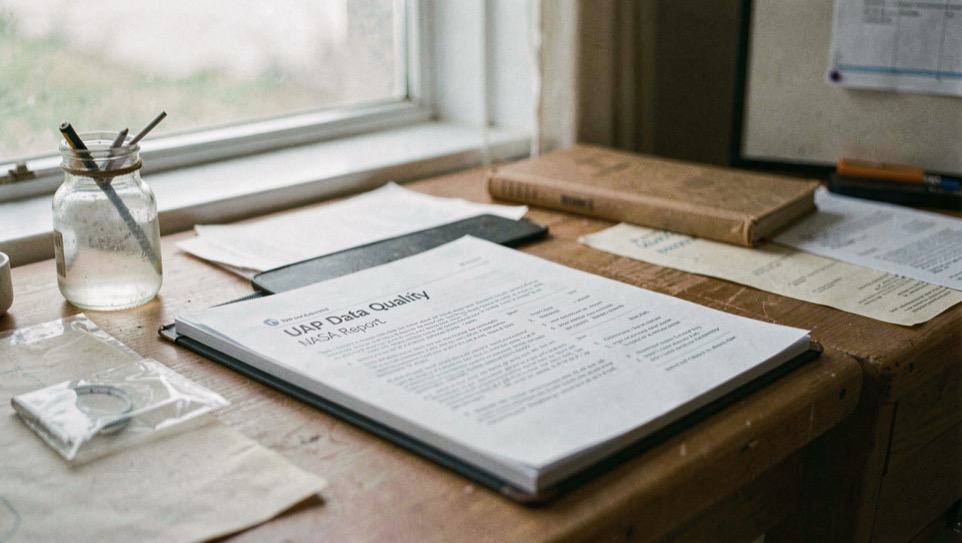
Data quality in UAP reports depends partly on the stories witnesses already carry. A sighting gets shaped by films, television, and folklore before anyone files a form, and that shaping is hard to separate from the observation itself. Curators face the same problem when they program older cinema: audiences arrive with expectations that color what they notice on screen. A practical example is building a noir repertory cycle, where context notes and screening order change how viewers read a single scene. The lesson transfers. Document the framing, not just the event, and reproducibility improves. The NASA report on UAP data quality notes that a sighting record is only as reliable as its metadata: who reported it, when, from where, and with what instrument. The same logic applies to objects. A clock without a documented maker, movement, or provenance is unidentified in the ordinary sense, not extraordinary. Before treating any anomaly as unexplained, check whether the basic record was ever established. For physical objects, that work resembles dating an antique clock: start, date, restore, in that order, with the evidence leading the conclusion rather than the other way around. A record is only as good as the attention brought to it. The same holds for the observer. Before judging a sighting, note the conditions: sleep, stress, light, and how long the witness had been watching. These details shape what gets reported, and they belong in the metadata. Analysts who read reports closely often borrow a habit from contemplative practice, settling attention with the breath before returning to the page, so that a gap in the data is recorded as a gap, not filled by assumption. The NASA report on UAP data quality stresses reproducibility: a sighting is only as useful as the record around it. Metadata gaps, missing timestamps, and uncalibrated sensors all weaken a case before interpretation begins. Eyewitness limits work the same way. Attention drifts, memory fills holes, and the difference between unidentified and extraordinary gets lost. Hand work offers a modest counterweight. Counting rows, holding tension, and reading a pattern train the same patient noticing that careful observation requires, much like learning crochet stitches from the first chain before attempting a full project. The habit transfers: slow down, check each step, and record what is actually there. Folklore and anomalous reports share a similar problem: the story often outruns the source. A witness may describe a light in the sky, and by the time the account is retold, the light has become a craft. The same drift happens with calendar customs. Tracing where Halloween customs come from shows how Samhain observances, later church holidays, and nineteenth century immigration each added a layer, and how pumpkin carving arrived late. Read the earliest available text before trusting a summary. That habit serves both folklore and UAP data quality. Data quality in UAP reports depends on the habits of the people who file them. An eyewitness account is shaped by routine, language, and expectation long before anyone plots it on a chart. The same is true of religious practice. A congregation's weekly rhythm, its hymns, and the quiet repetition of prayer all train attention in particular ways, and a field note on the order of a Lutheran service shows how belief, family, and habit reinforce one another across generations. For researchers, that is a reminder: unidentified does not mean extraordinary, and a report is only as reproducible as the context behind the observer. The NASA report's caution about metadata applies beyond sensor logs. Eyewitness accounts also carry context that is easy to drop: who recorded the observation, when, and under what local conditions. The same discipline helps when reading cultural material. A traveler's note on onsen bathing customs describes washing before entering the water, keeping hair tied, and leaving towels out of the pool. Those details are not trivia. They are the metadata that makes a report reproducible and comparable, whether the subject is a light in the sky or a soak in a hot spring. A NASA report on UAP data quality makes the same point that applies to any field investigation: the record matters as much as the sighting. Missing metadata, inconsistent formats, and unchecked eyewitness accounts limit what anyone can later verify. The practical fix is procedural, not interpretive. Decide in advance what to log, how to label media, and how to separate a raw observation from a conclusion drawn afterward. For readers who want a concrete method, this guide on how to document paranormal activity covers logs, media handling, interviews, and review steps. An unidentified case is not an extraordinary one until the record supports it. Eyewitness limits sit at the center of UAP data quality. A report is a person's account, filtered by attention, expectation, and the conditions of the moment. Researchers who work with such accounts often note that timing matters: a sighting at the edge of sleep, or on waking, follows a different pattern than one logged in daylight. The same care applied to metadata gaps and reproducibility can be applied here. For readers trying to place an experience, a respectful explanation page on paranormal experiences during sleep may help separate an unidentified report from an extraordinary claim. A working record is what separates a puzzling observation from a claim that can be checked later. The NASA report on UAP data quality makes this point about metadata: without a consistent account of who recorded what, when, and with which instrument, a sighting cannot be reproduced or compared. The same discipline applies far from the sky. Anyone documenting repeated outdoor work, whether field observations or a season by season studio log, benefits from dated entries, stable methods, and notes on conditions. Write down the gaps as carefully as the findings. An unidentified event stays unidentified until the record is good enough to rule out ordinary causes. Data quality work asks for quiet attention: reading metadata, checking a witness account against the record, separating what is unidentified from what is extraordinary. That kind of focus is hard to sustain in a noisy week. Some researchers step away on purpose, and planning a first silent retreat covers what a weekend of silence involves, how to prepare, and how directed and preached formats differ. The aim is not insight. It is a calmer setting for ordinary observation, which is often what careful review requires. The NASA report on UAP data quality stresses that a record is only as reliable as its naming and provenance. The same discipline applies to any catalogue, including cloth: a tartan entry is checked by name, region, and threadcount before anyone treats it as settled. For a worked example of how a register handles those fields, and what a threadcount actually records, see this note on searching the tartan register. The lesson carries over. When a source does not state who compiled a record, when, or from what, the gap belongs in the write-up, not in the conclusion.